




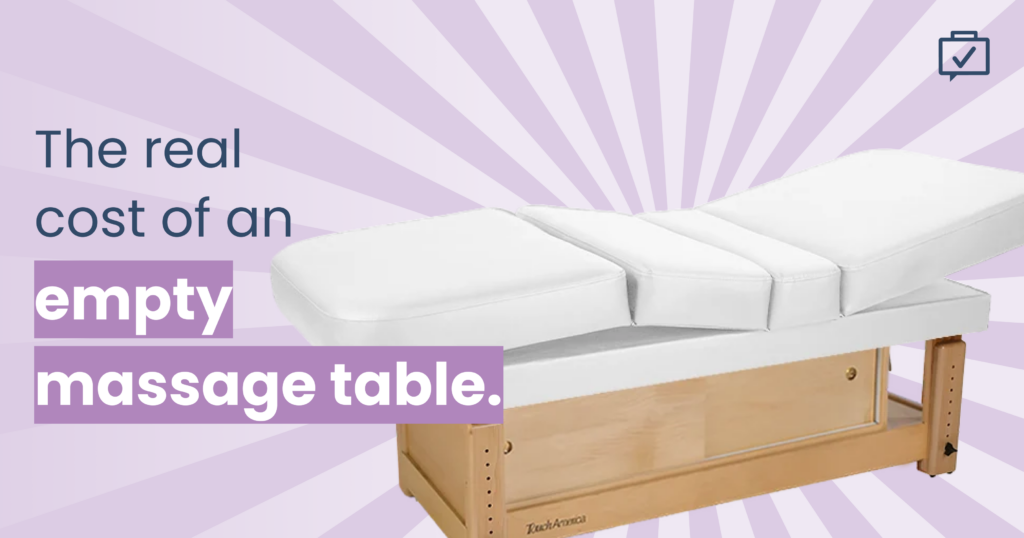
The real cost of an empty massage table isn’t zero. It’s rent, it’s a booked-but-unused block of your practitioner’s time, it’s the lead cost that brought a client to your door in the first place, none of which disappears just because no one is on the table that hour. For massage therapists, spas, fitness studios, and wellness coaches, room and chair time is the actual product you’re selling, and every unbooked hour is inventory that expired the moment the clock ran out.
Unlike retail inventory, you can’t restock an empty 2pm slot tomorrow. That’s what makes occupancy the single most important number in a wellness business built around one-on-one time, and why the pros who track it closely tend to run steadier, more predictable schedules than those who don’t.
Why Wellness Occupancy Is Different
Most wellness businesses have a hard ceiling: one practitioner, one room, a finite number of hours in the day. That means the occupancy conversation isn’t about adding more space, it’s about protecting the value of the space you already have. A full calendar with the wrong pricing is just as costly as an empty calendar with the right one. Getting the balance right is what separates a business that’s busy from one that’s actually profitable.
Advice from the Pros: Two Ways to Handle the Peak-vs-Slow Question
We asked PocketSuite wellness pros how they manage high-demand days, like holidays, against the slower mid-week stretch every practice knows well. Their responses split into two clear camps, and both are working.
The Consistency Camp: Hold the Line on Pricing
Several pros told us they intentionally keep pricing flat year-round, treating a stable rate as part of the client experience itself.

Darren Chittick, Beech Grove Wellness
“I charge the same price across the board. I don’t need to offer discounts, as my books are typically full. I didn’t have a significant slowdown at the holidays.”

Alejandrina Collado, Kneaded for Life
“No, I prefer to keep the prices as they are.”

Mari Allday, Pushing Boundaries Bodyworks LLC
“I feel like I’m at the point in my career where I am steady enough year-round, but I did benefit from gift certificate sales around the holidays in my first year of business.”

Dominic Anastasio, Forza Fitness – Oakwood/Kettering
“Our schedules and pricing stay consistent year round.”

Benjamin K Greene, Greene Performance & Wellness Coaching
“Our business slows during holidays and summers. Our clients are high performers that don’t follow the standard calendar. We also do not do promotions because that would actually hurt our brand. We aren’t for everyone and we make that clear.”

Brandon Bykowski, Spot On Massage LLC
“No I don’t. I am just 7 days a week and still figuring out stuff.”
The Strategic Promotion Camp: Targeted, Not Sitewide
Other pros use focused, time-boxed offers to fill specific soft spots without discounting across the board.

Danielle Santiago, Ageless Beauty Med Spa
“Yes. Currently Fridays are slow, so we hold ‘Shot O Clock’ Fridays. Clients can walk in and receive any injection at a Promo price. If they can’t come in they can request an invoice during Shot o clock only and receive the discount price but the invoice must be paid before closing on Fridays.”

Kayleigh Weber, Cicada Massage
“We offer extra add-ons for free if people book around the holidays in advanced so that we know what our schedule will look like and we can gauge accordingly, but I try not to do too many discounts cause it brings in clients that don’t come back and I would rather my consistent clients just get a free add-on.”

Nicholas Holtzman, Fitness Professionals, LLC
“Yes, I have a great team doing about 2-3 promos per month.”
Both camps are protecting room ROI. One does it by keeping the value proposition unchanged. The other does it by using a small, specific incentive, tied to a known slow day, rather than a broad discount that trains every client to wait for a sale.
Finding Your Own Empty-Table Math
Whichever camp fits your business, the starting point is the same: know your number.
- Calculate your break-even hourly rate, including rent, product cost, and your own time, so you know exactly what an empty hour costs you
- Identify your one or two consistently soft time slots (a specific weekday, a specific hour) rather than treating “slow season” as one big blur
- If you choose to run a promotion, tie it to that specific slot, like Danielle’s Friday model, rather than discounting your whole calendar
- If you choose to hold pricing steady, use loyalty touches, like Mari’s gift certificates, to smooth revenue during slower stretches instead
How PocketSuite Helps You See the Empty Table Before It Costs You
Set up each treatment room or table as a Resource inside PocketSuite, and if you run multiple identical rooms, group them so any available one gets assigned automatically, keeping your schedule packed tightly instead of scattered across rooms. The Resource Calendar gives each room its own row so an open table is visible at a glance, and Smart Reports show utilization and average ticket value by practitioner and by time slot, so you can spot your real soft spots instead of guessing. Appointment buffers protect the turnaround time between sessions so a full calendar doesn’t quietly become a burned-out one. And if you run targeted promotions like Danielle’s Friday model, you can build them as a limited-time package or a Smart Campaign that only reaches clients on the days you actually need to fill, keeping the offer precise instead of sitewide.
The table doesn’t care whether it’s full. Your bottom line does.